Thanks for joining me!
Good company in a journey makes the way seem shorter. — Izaak Walton

Musings on Library Life
Thanks for joining me!
Good company in a journey makes the way seem shorter. — Izaak Walton
As I look back over the past few months of this course I thank @michael for challenging us to think outside the box. I have enjoyed the use of blogging to present our ideas leading to much interaction between all of us and I thank all of you who made comments and gave me suggestions. I used the assignments and reflections to “think out loud” about ideas that pertained to my life both in and out of the library and I have come up with some plans to pursue that I don’t think would have occurred to me otherwise.
My takeaways from this course are summed up in the following quotes from the section on “Color Me Curious” in The Heart of Librarianship (Stephens, 2015)
It is my desire to keep on learning always that gave me the impetus to pursue my MLIS.
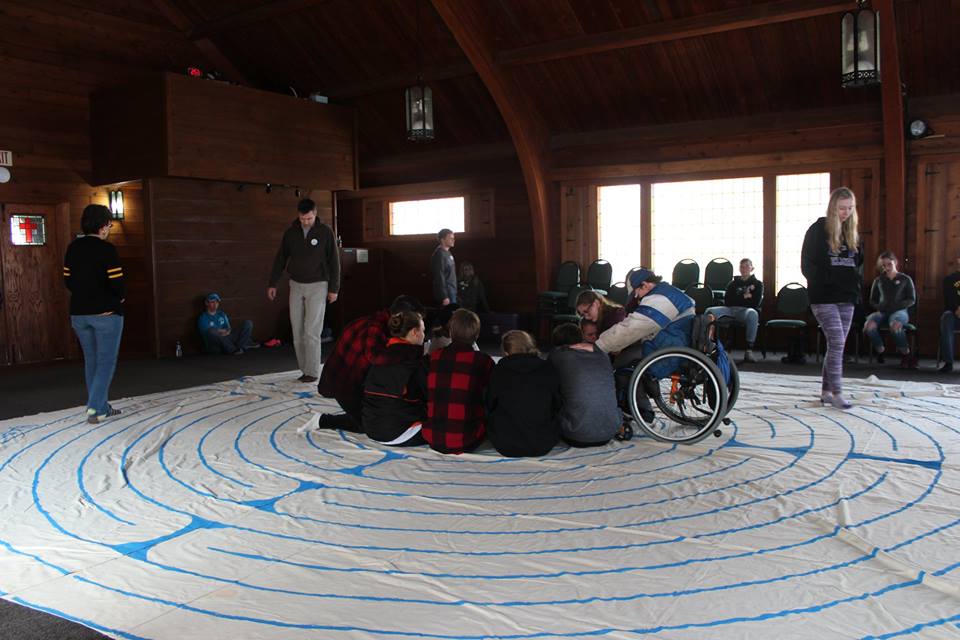
I also thank @michael for reminding us to “breathe”. It is something that I have learned to do more often as I have gotten older. A few times a year I get away from the regular routine through my work with youth groups. While my library is only a mile from my house, my speech job is about 33 miles away and that drive time is great for “thinking” – a way to work out problems, figure out my homework in my head, or just breathe. Here I am walking the Labyrinth last month (on the left in my black and yellow Hufflepuff sweater). This is one of my favorite ways to get refocused.
So as we end this course I leave you with a toast to all of us. Best of luck to all who are graduating and to those of us who still have a ways to go……remember to stay true to yourself and your ideas. Here’s to Us!
References and Resources
Halestorm. “Here’s to Us”. Retrieved from https://www.youtube.com/watch?v=sRXXGMSOiQM
Stephens, M. (2015). Color Me Curious | Office Hours. In The Heart of Librarianship, page 34.
While I was exploring the Infinite Learning materials in Modules 11 & 12, I was first drawn to the concept of “Learning Everywhere” and then to “Library as Classroom” thinking that they would give me suggestions for how to expand learning opportunities in the library and for my community. Many of the readings connect to those topics I have marked as “Directors Brief? Comp O?” and they are serving as my inspiration for that assignment.
I then moved on to listening to the lecture for the “Professional Learning Experiences” section of the module and when I went to that page I fell in love with the following quote.
“We are born to learn, but somewhere along the way many of us pick up the idea that we must be taught in order to learn………….We must regain our sense of wonder and our desire to learn.” — R.Tennant, “Strategies for Keeping Current,” Library Journal, 9/15/2003, p.28.
In further exploration of the module I hit upon the article by Tomas Chamorro-Premuzic (2015) which discussed the ways in which a person’s personality determines the ways in which they learn. I would place myself in the following categories:
Deep Learners:
Hungry Mind:
When I finished my first graduate degree in Speech Pathology and Audiology I said I was “done with school”. At that point I had been going non-stop for 17 years, beginning when I was not yet 5 years old. Soon after I began my professional career the head of my agency introduced me to joys of “going to Convention” (interestingly in the speech world we always refer to it as a “convention” but in the library world it’s a “conference” – a “conference” in the speech world is typically a one day event as opposed to the longer multi-day events). Over the years I have become affiliated with a number of professional organizations in both the speech and library worlds. As I spoke to in a previous blog, “we are all parts of a greater whole” and I have found networking through these educational opportunities to be an essential aspect of feeling joined to that greater whole.
I whole-heartedly agree with the findings of both Michael Stephens (2018) and Holly Clark (2019) regarding ongoing professional development. Over the years I have found that I have gained much more useful information from shorter presentations at conferences/conventions than I have at all day trainings. Invariably the speaker spends the majority of the day giving background information and the results of research studies and then rushes through the real “meat” of the presentation which are the real world applications we are hoping to take home with us. I fully take advantage of on-demand webinars ($99/year for open access to everything available on SpeechPathology.com and free access on edWeb for all things education and library related). Recently I was able to brush up on evaluation of stuttering the night before doing an evaluation by watching a one-hour webinar.
Forced opportunities for mentorship were not as successful as when people have been given the opportunity to seek out a mentor when needed. At our quarterly speech department meetings we typically set aside time for “sharing” where people are invited to either ask for suggestions from the rest of the department or share relevant information from an education opportunity they attended. In this way we can mentor each other in a more natural way.
Our library system has done well with providing trainings that are regionally based and hands-on when teaching specific technology based skills. Quarterly meetings at the system level bring together members from the 33 libraries to share information.
The “23 Things” initiative reminded me of the way INFO 203 is structured and I found that to be immensely helpful in getting introduced to the skills needed to participate in the online learning environment.
As my library has begun to expand into offering more adult programs, I recently served as a presenter and facilitator at 2 technology based programs. Without realizing it, I was trying to build “New Media Literacies” (USC Annenberg, 2013) amongst the attendees such as encouraging them to
Having taught those sessions is leading me toward considering taking INFO 250 – Design and Implementation of Instructional Strategies for Information Professionals in an upcoming semester.
References:
Blowers, H. (2006). About the Learning 2.0 project.
Chamorro-Premuzic, T. (2015). How your personality determines how you learn.
Clark, H. (n.d.). The essentials of great PD: How educators are reimagining professional learning.
Stephens, M. (2018). Personal, Actionable, Accessible
USC Annenberg. (2013). Create circulate connect collaborate.
Ever since I read the article “Don’t hate the phone call, hate the phone” (Bogost, 2015), I have had the AT&T jingle “Reach out, reach out and touch someone” in my head. Not only was that a nostalgic glimpse into my youth, but it got me thinking more about the ways in which I use my phone to “touch” multiple people, in a variety of ways, throughout each day.
My husband would say I have a love affair with my cell phone and after reading the Deloitte survey (2016) one might think that I am a British mobile user between the ages of 18-24. I am hyperconnected throughout the day via text, messaging, and e-mail – all accessed through my phone. When we need to know information right now I just say “OK Google” and find us the answer. I end my day playing games and start each day looking at my phone, and I never turn it off. I am seriously considering the need to update my phone simply for the reason that it no longer supports the Dunkin’ App. We have a landline, with a wall phone because it still works when the power goes out, but I never answer it because if someone really wants me they know to call my cell. It’s the only number I ever give out.
My husband, on the other hand, barely knows the purpose of a cell phone. He still has a flip phone, hardly ever has it turned on unless he is expecting a call, and he hates to text. This is not to say that he is not technologically savvy. He is the moderator on a well regarded tool company forum and he is the one our neighbor calls whenever she needs IT help (she can’t find her imported pictures – again, the printer won’t print, Skype isn’t working) but he just doesn’t see the need to use a smart phone when his computer suffices and he would rather talk to someone instead typing a text.
Bogost (2015) says, “One of the ironies of modern life is that everyone is glued to their phones, but nobody uses them as phones anymore”. Again one might think I was one of the Millennials who are reported to think that phone calls are “intrusive” and make “unbidden demands for someone’s undivided attention”. This is exactly how I feel. But let’s put it into perspective. I am working 2 jobs and I am a student. My time is very limited and it is much easier to make simple contact via text than it is to make a phone call which as anyone knows can lead into much more conversation than just confirming “I’ll meet you there at 8:00”. On a regular basis I am texting the parents and teachers of my speech kiddoes to arrange for therapy, coordinating with another local librarian, contacting my assistant at the library, and coordinating with members of various church related groups – and these do not include any personal contacts that I may be making. Even as I’m writing this I am engaged in an ongoing FB Messenger with a teen about an upcoming youth retreat I am coordinating.
Bogost (2015) also comments on the changes in phone styles over time and how today’s smartphones actually are not that good for making calls.
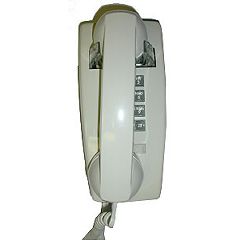
It’s very true that the hand set on this phone was much better for hearing the speaker and you could have those extra long cords so you could still walk around while you talked with it propped between your shoulder and your ear so that you could use your hands. As he also mentions, calls were also typically made in a more private setting so that there was not as much noise competition.
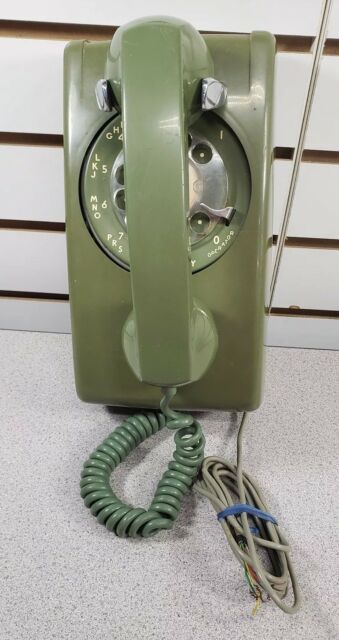
I don’t know if the divide between my husband and myself is based on our upbringing but there is a definite difference between our families in general regarding use of technology. My in-laws are 10-17 years older than my parents, with the distinction of them having lived during the Depression and World War II and my parents being Baby Boomers. My husband grew up in the “country” while I was more of a “city girl” who grew up on Long Island. My in-laws have a cell phone for use in emergencies but they still have this phone hanging on their kitchen wall. They have never owned a computer although they have asked us to look up information for them.
On the other hand, my family has always been on the cutting edge of technology. My parents had computers before I did and they have always had better internet infrastructure than we have. My niece and nephew (ages 7 and 9 ) have never known a world without smart phones and they could swipe to find what they desired before they were 2. They have always been somewhat disappointed with my lack of videos and games on my phone but now do enjoy playing all the levels I have unlocked on Candy Crush. They don’t yet have phones of their own, but they do text me on whoever’s phone they can get their hands on.
Using our phones is how my family “reaches out and touches” one another. We are in group chats frequently and share pictures about everything we do and whatever the kids accomplish. My mother and I have had an ongoing tradition for almost 10 years where we will text when certain songs are played on the radio. My son thinks we are crazy for continuing it but it’s a way to keep in touch and I love it when I get a text that says “Surrender” or “I Hate Myself” .
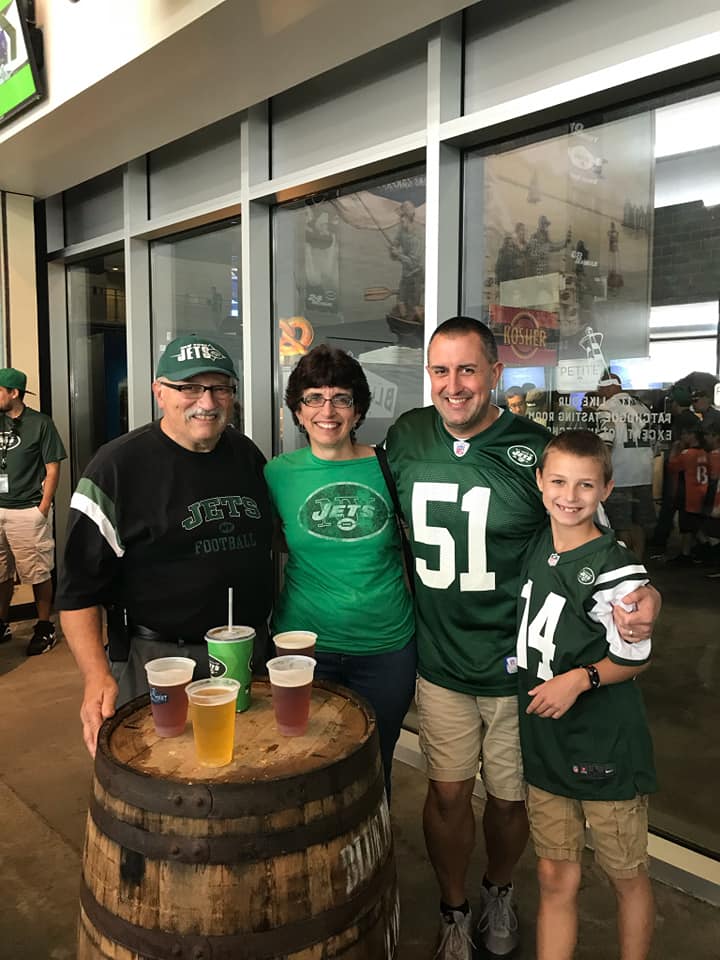
During football season I spend my Sundays in continuous texts with my brother and father about how much the Jets suck and we should become Bills fans (but honestly we have invested in too much green clothing to make that switch). My friend Mary has Red Zone so she texts about every game that is on. It’s all a matter of keeping in touch.
In my side of the family each person is invested in wearable technology, with each of the 7 of us from age 7-74 having a fitbit. They are so used to playing music through a Smart Speaker that my sister-in-law literally said “Alexa play Happy Birthday” when I had my cake this year. (Alexa also responds whenever the kids say “Aunt Lisa” but that’s another story).
I connect on Social Media primarily on Facebook although I also have Instagram and Twitter accounts. What a wonderful way to have reconnected with so many people from my past and grow new connections! Again, I am going for simplicity. I only have time to deal with one of them on a regular basis and since I am managing 5 other FB pages that’s my go-to. The library and church pages are linked to our Twitter accounts so I only have to post in one place. People are able to contact us via those media, and although I would like to make our library website more interactive, people do have the ability to e-mail us through the site. We have a few tweens/teens who are within walking distance of the library who will hang out on the porch to use the wifi in the warmer temperatures but they don’t typically come in to use it during the colder months. We need to find a way to make better connections with them.
It’s technology’s world and we are living in it. We just need to remember to “reach out and touch someone” in some way throughout the day.
References
Bogost, I. (2015). Don’t hate the phone call, hate the phone. The Atlantic. Retrieved from https://www.theatlantic.com/technology/archive/2015/08/why-people-hate-making-phone-calls/401114/
Deloitte Survey. (2016). How do today’s students use mobiles? Retrieved from https://www2.deloitte.com/uk/en/pages/public-sector/articles/how-do-todays-students-use-mobiles.html#
Media
1980s wall phone. Retrieved from https://www.allegromedical.com/daily-living-aids-c519/cortelco-traditional-mini-wall-phone-p560608.html?CS_003=9164468&CS_010=ff80818124a5c0080124a74b685b00ac&gclid=EAIaIQobChMIrcqx4IWt4QIVBI3ICh1zkw9lEAQYASABEgJsRfD_BwE#124A-74B6889
AT&T Ad. Retrieved from https://www.youtube.com/watch?v=yt6DvapiK-w
I Hate Myself for Loving You (Joan Jett). Retrieved from https://www.youtube.com/watch?v=bpNw7jYkbVc
Surrender (Cheap Trick). Retrieved from https://www.youtube.com/watch?v=LqB9lhHqmsE
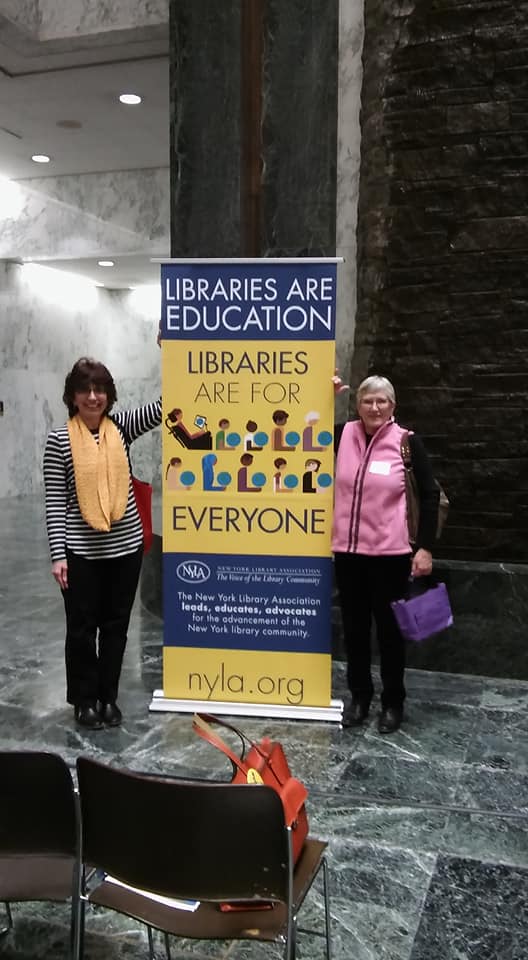
I’m writing this a week after attending Library Advocacy Day in Albany. Although I had mentioned this as an example of an idea that wasn’t quite “sticky” in my context book report, I still find it important to make ourselves and our value known to our representatives at the county and state level. I luckily have very supportive representatives in my districts (County Legislature, State Senate, State Assembly) but I know others have been a harder sell. The best quote of the day, from a Long Island representative, was “Libraries are like the Swiss Army knife of the community….they do everything!” so obviously she gets it too. Even though we have to go back each year to make our case, on a positive note NYLA reports that since 2011 the rallies have resulted in more than $11 million in library aid be added or restored. This year’s focus was on maintaining the amount available for construction aid. It doesn’t matter what services we offer if we are unable to have spaces to meet our needs and those of our communities, and this is a common theme.
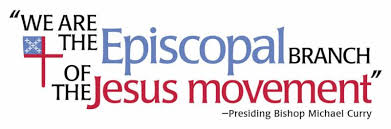
One of the reasons I try to participate in these efforts is that I truly feel that we are all parts of a greater whole and I make a point of joining in with the greater whole whenever I can. In my personal life this is demonstrated by becoming involved in church activities that extend to the diocesan level with my work on the youth council and to a national level by bringing a group of teens on an inter-denominational mission trip each summer. As Presiding Bishop Michael Curry says
We all have a common mission regardless of how we worship in our individual churches and denominations and that’s vital for people to be able to come together and work together for the common good.
In Library Land this means that even though we each have our own libraries, regardless of size or location, we all have a common mission to connect people and information to the best of our abilities. My library (Hazard Library Association) is part of a County Group (Cayuga Connect), a 5-county Library System (Finger Lakes Library System), the New York Library Association (NYLA), and the American Library Association (ALA). I personally belong to a number of other sub-groups as well. As I embarked on my “choose your own adventure” in Module 6 I chose to focus on both Public Libraries and Global Communities & Global Librarianship. While I find the architecture for both DOKK1 (Denmark) and Oodi (Finland) to be somewhat overwhelming, the idea of the library being the center of the community is such an exciting idea. In a small, rural community we are in a prime position to be that center due to few other resources available.

The “Four Space Model” which includes overlapping areas for Inspiration, Learning, Meeting, and Performance is something I can take into consideration as we embark on our expansion project. I think our space is always going to be limited but what we do with that space can be new and exciting. Just yesterday we received an architectural rendering which will allow us to move to the next step of our plan!
In looking at the information regarding other global libraries it was comforting to know that libraries across the world have similar concerns to those we face in our own libraries here in the United States. Everyone is trying to meet the needs of their patrons, even if the methods vary.

We met the needs of bringing books to our youth who did not have access over the summer using this “Bookmobile”, while Columbia has its “Biblioburro” and in Jagodina, Serbia they have a “Bibliocycle”

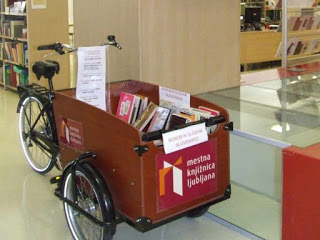
I went to our State Capitol to advocate for library funding while the Serbian librarians held a 4-day workshop on “Advocacy, Raising Awareness, and Communication for Libraries”. We did not have broadband service in our community until 2016 while at the same time Australia was also working towards digital inclusion. An interesting variance I noted was that while European libraries seem to be invested in cafes, the Oak Park Public Library in Illinois repurposed their cafe into their Idea Box.
Regardless of their size or location, each library is part of the greater whole of international librarianship, and we can all learn from one another.
Postscript: I wrote everything above this point earlier in the day and then headed to church for Ash Wednesday. Here is a quote from the homily, “We are connected to everything in creation. Sisters to the Stars, Brothers to the Moon” (Rev. Kathlyn Schofield). Yes, we are all parts of a greater whole.
References:
Digital Inclusion in Australia. (2016) Retrieved from https://digitalinclusionindex.org.au/about/about-digital-inclusion/
DOKK1 Website. (2019). Retrieved from https://dokk1.dk/english
The Four Spaces of the public library. (2016). Retrieved from https://blogs.ifla.org/public-libraries/2016/03/29/the-four-spaces-of-the-public-library/
Helsinki invests in its people with a library that reinvents itself. (2019). Retrieved from https://finland.fi/life-society/helsinki-invests-in-its-people-with-a-library-that-reinvents-the-genre/?fbclid=IwAR02YiMMaUOXanedOfFbDrzhou_4s1_oHQInvzYDk3bPJeu9Vx3D_ItX5Zs
Jagodina Public Library & AgroLib Ja project. (2016). Retrieved from http://jagodinalibrary.blogspot.com/
The Jesus Movement. (2018). Retrieved from https://www.episcopalchurch.org/jesus-movement
Librarians to rally in Albany for funding on Wednesday. (2019). Retrieved from http://dailyorange.com/2019/02/librarians-rally-albany-funding-wednesday/
Oak Park Public Library Idea Box. (2019). Retrieved from https://oppl.org/visit/idea-box/

What struck me the most, and put all the other readings into perspective, was the Customer Service Philosophy of the Gwinnett County Public Library presented by Michael Casey in his conversation on 2/21/19. As I have read over the key points, and considered them, I have been weighing our services to see where we are meeting these goals and where we may be falling short. I am familiar with the concept of providing “Radical Hospitality” when I serve with Group Mission Trips each summer, but am I providing that same level of service, to meet all the needs of our patrons, to say “yes” we can make that happen regardless of the request, within the library setting?
KNOWLEDGEABLE & PASSIONATE – One of the considerations for prospective librarians that @Michael mentions in “The Heart of Librarianship” (pp 55-56) is the need to help people “find things”. Michael Casey says we should be enthusiastic about providing creditable resources to the community. I think we are meeting this objective. We continuously provide new materials to the community and find ways to get what they want as quickly as possible either through ILL or by ordering requested materials to add to the collection. However, we could do better in educating the public about what additional services are available using their library cards through the Finger Lakes Library System. And what are the needs that we aren’t meeting? We need to expand our participatory avenues to gain more feedback. We often ask questions on Facebook which do not always gain many responses and we do not have an ongoing blog connected to the website where responses are an option.
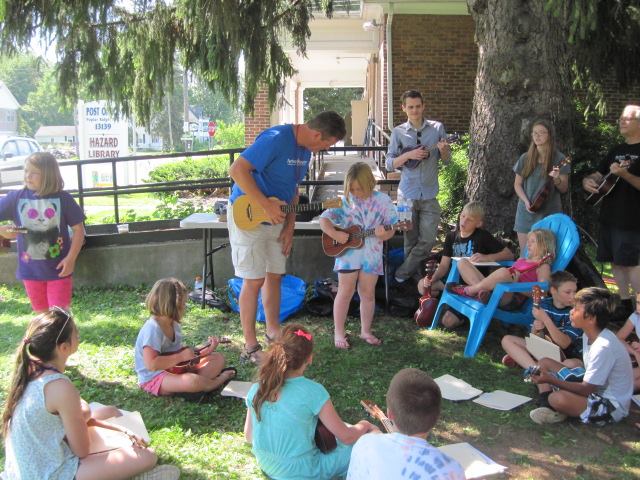
INNOVATIVE – I love to see the new ideas offered by various libraries and to try to envision making them work in our space. One the most exciting I’ve seen is the Idea Box found at the Oak Park Public Library. It looks like they even paint it as they change their interactive exhibits! Oh to have the space to do something like that. Over the years we have had some innovative experiences, like Ukulele Camp, even if they weren’t our own ideas, but maybe there are in-house service options to consider (the Open+ option as described by Michael Casey would be a bit too much for us but I am looking to expand our service area and hours). Seeing Ann Arbor’s Summer Game has given me an idea for our Spring Break activity – an online Scavenger Hunt. I have seen other libraries move away from “Summer Reading” to “Summer Learning” but we tend to do a combination of learning activities paired with continued use of reading logs because of our tie to the school district’s Literacy Committee.
FOCUSED & FRIENDLY – This is an area I think we have mastered. In reading Aaron Schmidt’s article about “Earning Trust”(2013) I think we are meeting his guideposts of providing quality face-to-face customer service and building the trust of our patrons. We show our personality and have established strong relationships with a number of entities in our community. We help our patrons to be successful. I think our website is user-friendly, although it could use some updating, and we post regularly on Facebook, offering interactive opportunities there for our patrons.
EQUITABLE & COOPERATIVE – As I discussed in my first discussion post, “My Evolving Life”, I am currently struggling with the decision of whether or not to go “fine free”. Despite the fact that we continue to charge fines I think we do, as stated in the GCPL Customer Service Philosophy, “give every customer the benefit of the doubt and work to accommodate unique situations with equitable solutions” so that we are not alienating people due to life circumstances. Although not included in the definition of this box, we are highly “cooperative”, frequently collaborating with other community entities such a neighboring library, the school district, the food pantry, and most recently with the Historical Association to provide joint programming.
TRANSPARENT – Another of Aaron Schmidt’s (2013) hallmarks of “Earning Trust” is Honesty. This is an area we need to improve upon. We have our Board Minutes published on our website (although I am a couple of months behind and I just realized that our Annual Report has not been updated since 2013 – I didn’t even realize that was on there – oops!) and we do provide a printed Annual Report to our patrons at our Annual Meeting and when they come to the library. At this time we are in negotiations with the Post Office, who rents half of our building, to reduce their space so that we can begin an expansion project. This is a topic that I have preferred to keep less than public until we have something more substantial to present to them. Is this “hiding” something? I’m not sure, but right now I don’t have any answers to give to questions other than what I have stated so I’d rather not have rumors circulating.
INCLUSIVE – This is an area that needs much improvement. Our otherwise rather homogeneous community has become diversified by a growing number of Hispanic farm workers. We collaborate in some ways with the food pantry to provide books in both English and Spanish for their Healthy Bodies, Strong Minds initiative, and have gone to the food pantry for a library card drive, but those families have not yet come to the library and Spanish language books that we have do not circulate. Part of our need for expansion centers on the fact that we are not ADA compliant. There is a wheelchair ramp to get up to the porch and our doors can be opened to accommodate entry, however once inside there is little space for anyone to maneuver, much less in a wheelchair, and our bathroom is not accessible.
The readings for both Modules 4 and 5 left me thinking of aspects of Participatory Service and Transparency that need to be addressed in order to be a viable library in the 21st century. The impetus for change lies in my hands and that it why I am pursuing this degree.
References
Ann Arbor District Library’s Summer Game Demo. (2011). Retrieved from https://www.youtube.com/watch?v=XZd6uiM34C8 .
Finger Lakes Library System eSources. (2019). Retrieved from https://catalog.flls.org/polaris/search/misc/esources.aspx?ctx=1.1033.0.0.3
Group Mission Trips. (2019). Retrieved from https://groupmissiontrips.com/
Gwinnett County Public Library Open+. (2016). Retrieved from https://287.hyperlib.sjsu.edu/wp-content/uploads/2016/10/Open-handout.pdf
Gwinnett County Public Library Customer Service Philosphy. (2019). Retrieved from https://drive.google.com/drive/folders/1PH_vh3xsy_8mODFH99DvsAnCs1DATYrt
King Ferry Food Pantry Healthy Bodies, Strong Minds. (2019). Retrieved from https://www.facebook.com/KingFerryFoodPantry/photos/a.479703645830429/561975027603290/?type=3&theater
Schmidt, A. (2013). The user experience: earning trust. Library Journal, (LI, 11/5/13). Retrieved from https://www.libraryjournal.com/?detailStory=earning-trust-the-user-experience
Stephens, M. (2016). The heart of librarianship: Attentive, positive, and purposeful change. American Library Association. pp 55-56.
Hi! Here is the link to my Context Book Report. I read “Made to Stick” by Chip Heath and Dan Heath. I put it on a separate page. I actually referenced it today when giving a talk on how to write a talk. It was something I have given in the past, to some of the same people, but they did seem to be nodding in agreement when given the suggestions I had pulled from the book regarding getting to the core of the message and illustrating it with stories that get to the heart of the matter. This assignment is already paying off!
I admit that I am “old”. I have witnessed and participated in the remarkable changes seen in library services and practices, how students research information, and the ways in which business is conducted online. In doing our readings I really connected with the “Cluetrain Manifesto” and Buckland’s thoughts on “Redesigning Library Service” because I have been directly involved in the evolution that they predicted.
In high school, college, and my first grad school experience, all of my research was conducted through use of the card catalog and some use of microfilm/fiche. Those machines were impossible to use! As a general rule we did not have access to databases or any training in using them if they were available. Until I began this program in 2017, although I had received training in how to use the databases through our Library System, I had no personal experience in using them and was somewhat “afraid” of them.
My first career is as an itinerant pediatric Speech/Language Pathologist. I have been working for the same agency, with a merger occurring in 2010, since 1991. When I first began, all of our paperwork was literally that……all conducted on paper and handwritten. Our first breakthrough in technology was provision of a fax machine so that we could fax our handwritten reports to the agency to be typed.
In 1998 I moved into our current residence and began using the library where I am now the Director. It was there that I first began to go online and set up my first e-mail account. We first had internet service in our home in 2000 via dial-up. It was so slow but so wonderful to be “connected”. In the next decade the way in which our agency conducted business transformed into a online model with all contacts conducted via e-mail, reports being written and shared electronically, and session notes now being entered online. As this next decade is coming to an end, we are moving into a more fully cloud based system, and as new features have been developed, input from us as users has been essential. Our home internet service has also evolved. We traded unlimited use for increased speed when we were able to connect via a “hot spot” and finally in 2016 we were able to have it all.
So, where does my work in the library fit into this? In 1998 the library was still checking out books using stamps for due dates in the card pocket. There was no thought for privacy and we signed our names on the cards for all to see. The first online system was introduced in 2000 and I was one of the volunteers that placed the barcodes on all the library materials. When the previous Director retired in 2013, after 30 years of service, she had kept this small library up-to-date on many technical advances, however when I came into the position I found some discrepancies that did not make sense.
Why oh why were we still having books processed with card pockets, with cards included, when we had been automated for 13 years?

Why were we still filing cards into card catalogs, which were kept behind the circulation desk and never accessed by patrons, when we had an online catalog for patron use?

Why was I told to print out the full report for circulation statistics when I could access the report online and just record the current data in my own spreadsheet?
Why did we have 4 separate machines (black and white printer, color printer, copier, and fax) taking up space we don’t have to spare when we could have an all-in-one?

In the past 6 years we have made changes to the ways in which we order materials so that patrons have access to books on day of release and we have been told that “You are better than Red Box” in having new movies available. We have cut out the unnecessary processing expenses. We have become much more efficient and moved into a more modern service model and I am working to keep up with trends.
I am now struggling with the trend towards eliminating fines, which has become a primary focus in our library system. Our fine structure is so low that a full week overdue will only cost a patron .30. With auto-renew in place, unless a book is on hold for someone, a patron will be able to have an item for 9 weeks before it actually becomes overdue. We are willing to waive fines for various circumstances but also have patrons who will willingly pay for the book that can’t be renewed so that they can finish it. I have also seen people who “abuse” the privilege of borrowing items that belong to everyone and just don’t return them. Really, if you’ve had the book for over 2 months, and you still haven’t read it, please just drop it into the drop box when you go by.
My goals as Director are to continue to grow our library both in size and presence, as we offer quality 21st century services to our rural community. Our circulation desk serves as “everything” so I would also like an office.

Hi everyone,
I live in the Finger Lakes region of New York where we are in the midst of the arctic blast of winter. My first degree and profession are as a Speech/Language Pathologist but since 2013 I have also been the director of a very rural and very small library which shares a building with the Post Office.


I began with my love of libraries very young in life, with my first “job” in a library when I was in 4th and 5th grade as a “Library Helper” and then as a paid Page in High School. At the time it didn’t seem to be my calling in life but when we moved into this community I became involved in the library as a volunteer, then a board member, and when our director of 30 years retired I applied for the position. I find it unbelievable that the director of a small library does not need to have any specific education to perform in the role of basically running a business!
After a couple of years I began to consider pursuing my library degree. There were many details I related to the library world that I wished I was more knowledgeable about so that I could make sure I was doing things “right”. A colleague of mine was attending SJSU and the idea of an online degree seemed perfect, however the digital divide is real and we did not get broadband internet service at my home until September 2016. I applied to SJSU the day after it was installed and was accepted on my birthday in October 2016. Later that month at the Finger Lakes Library System Annual Meeting, the guest speaker was none other than……Michael Stephens! And the topic of his talk? The Hyperlinked Library! I have been hoping to take this course ever since that time, and I hadn’t even begun the program yet. Unfortunately, he had to leave prior to the end of the meeting and I didn’t get a chance to meet him.
I continue to also work as an SLP so I am only able to handle one class at a time. This class will put me at the half-way point in my journey to my MLIS. I have subtitled this blog “my #hyperlib Adventure” because I find each new class to be the beginning of another adventure. What am I going to learn this time? How am I going to be able to put that information/skill to use? It has been very exciting!
I am looking forward to getting to know all of you through your blogs and to get some extra practice in using Word Press. While I do maintain our website Hazard Library Association and our Facebook Page, I admit I am not always very creative and would love some insight and pointers.
 Lisa's Library World